
Key Takeaways
- Not all probiotics survive stomach acid. A probiotic must first pass through the highly acidic environment of the stomach before it can reach the intestines and support gut health.
- The probiotic strain matters. Different strains have different characteristics, and clinically studied strains are more likely to have documented survival and health benefits.
- CFU count isn’t everything. A higher number of colony-forming units (CFUs) doesn’t guarantee effectiveness if the bacteria cannot survive the journey through the digestive tract.
- Formulation plays an important role. Acid-tolerant strains, protective formulations, and proper storage all help improve probiotic viability.
- Choose probiotics backed by clinical research. Look for products that clearly identify the probiotic strain and are supported by published scientific evidence, such as BioGaia’s clinically studied Limosilactobacillus reuteri strains.
Choosing a probiotic isn’t just about finding the product with the highest colony-forming unit (CFU) count. Before probiotics can support your gut health, they first need to survive one of the toughest environments in the human body: Your stomach.
Stomach acid plays an important role in digestion and protecting the body from harmful microorganisms, but it can also destroy delicate probiotic bacteria before they reach the intestines. This means that not all probiotics are equally effective, even if they contain billions of live bacteria.
So, how can you tell if a probiotic is likely to survive the journey? In this article, we’ll explore what research says about probiotic survival, what “acid-resistant” really means, and why the probiotic strain may be just as important as the number of CFUs listed on the label.
Why Stomach Acid Is a Problem for Most Probiotics
Before probiotics can provide health benefits, they must first survive the journey through your digestive system. The biggest obstacle is the stomach, where gastric acid has a pH of approximately 1.5 to 3.5. This highly acidic environment is designed to break down food and destroy harmful microorganisms before they enter the intestines.
Unfortunately, stomach acid doesn’t distinguish between harmful bacteria and beneficial probiotics. Because probiotics are live microorganisms, many strains are highly sensitive to acidic conditions and may lose their viability before they ever reach the gut. If too few live bacteria survive this journey, the probiotic is less likely to deliver its intended health benefits.
Scientific research has shown that probiotic survival depends largely on the specific strain and how it is formulated. A 2024 review published in Nutrients found that probiotic species, strain selection, and delivery method all influence whether sufficient live bacteria survive passage through the upper gastrointestinal tract to reach their site of action. The researchers also reported that some formulations delivered more than 50% of viable bacteria, while others achieved less than 1% survival under simulated digestive conditions.
This is why choosing a probiotic isn’t simply about selecting the product with the highest colony-forming units (CFUs). A clinically studied probiotic strain that has been shown to survive stomach acid is far more likely to reach the intestines, where it can interact with the gut microbiome and support overall health.
What Does “Acid-Resistant” Actually Mean?
Not all probiotics survive stomach acid in the same way. When a product claims to be “acid-resistant”, it may refer to the probiotic strain itself, the way it’s formulated, or both.
Some probiotic strains are naturally acid-tolerant, meaning they have inherent characteristics that allow them to survive acidic conditions without additional protection. These strains are more likely to remain viable as they pass through the stomach, making strain selection an important consideration when choosing a probiotic.
Other probiotic products rely on microencapsulation, a process that coats the bacteria with a protective layer to shield them from stomach acid. Another common approach is the use of enteric-coated or delayed-release capsules, which are designed to remain intact in the stomach before dissolving in the small intestine.
Research suggests that formulation can have a significant impact on probiotic survival. Delayed-release formulations achieved substantially higher survival rates during simulated gastrointestinal transit than standard capsules, powders, or liquid formulations. However, the researchers also concluded that both the probiotic strain and its formulation influence survival.
Ultimately, a probiotic’s effectiveness depends not only on how it is delivered, but also on whether the specific strain has been clinically studied and shown to survive the journey through the digestive tract.
How Is L. reuteri DSM 17938 Different From Other Strains?
Not all probiotic strains are created equal. Even within the same bacterial species, different strains can have very different characteristics, which is why clinical research focuses on specific probiotic strains, not just the species name.
One of the most extensively researched probiotic strains is Limosilactobacillus reuteri DSM 17938 (formerly Lactobacillus reuteri DSM 17938). Unlike many probiotics, this strain is human-derived, originating from a strain first isolated from human breast milk. Because it is naturally adapted to the human gastrointestinal (GI) tract, it has evolved to survive and function within the digestive system.
What makes L. reuteri DSM 17938 particularly unique is that its survival has been demonstrated in human clinical studies. According to BioGaia’s published research, biopsies taken from different parts of the gastrointestinal tract showed that L. reuteri DSM 17938 was able to survive passage through the stomach and temporarily colonise areas including the stomach, duodenum, and ileum. This temporary colonisation allows the probiotic to interact with the gut where it is intended to exert its beneficial effects.
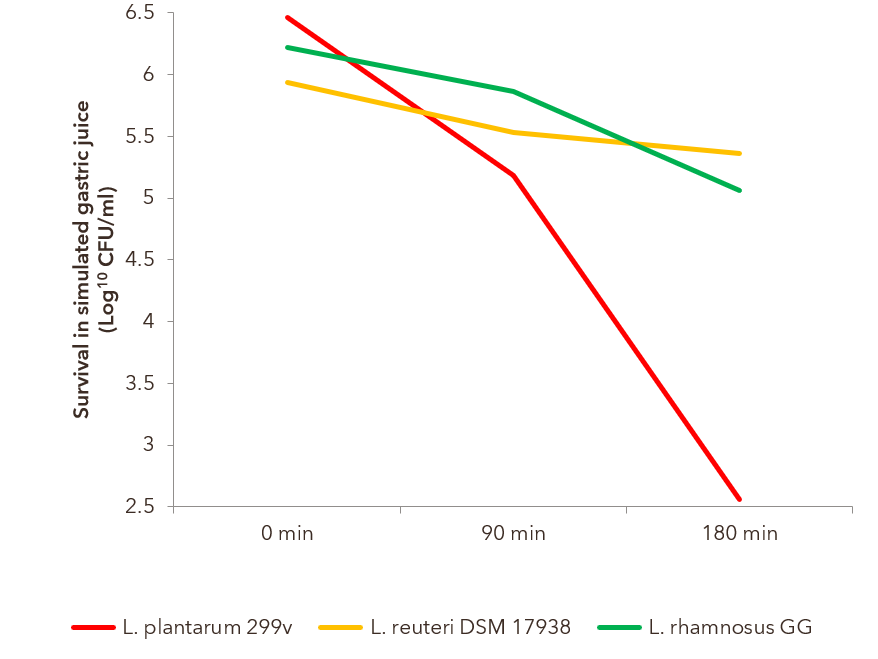
GI tract has pH < 3. Most bacteria, including most probiotics, decrease > 90% in numbers during gastric transit:
L. plantarum 299V, and L. rhamnosus GG in particular, decrease drastically under acidic environment.
L. reuteri DSM 17938 survive well without significant loss of CFU
This highlights an important principle in probiotic science: the effectiveness of a probiotic depends on the individual strain, not just the species or the number of bacteria it contains.
A strain with documented survival through the digestive tract provides greater confidence that the probiotic can reach the gut alive and deliver its intended health benefits.
What Happens After the Probiotic Reaches Your Gut?
Surviving stomach acid is only the first step. For a probiotic to provide health benefits, it must also remain active after reaching the intestines, where it can interact with the gut microbiome and the cells lining the digestive tract.
Most probiotics do not permanently colonise the gut. Instead, they temporarily colonise the gastrointestinal tract, allowing them to interact with the gut lining and existing beneficial bacteria before being naturally eliminated from the body.
During this time, probiotics can help maintain a healthy balance of microorganisms, support the gut barrier, and produce beneficial substances that contribute to a healthy digestive environment.
Probiotics also play an important role in supporting the body’s natural immune response. Around 80% of the immune system is associated with the gut, making the intestinal microbiome an important part of overall health. Research has shown that certain clinically studied probiotic strains can interact with immune cells in the gut, helping to regulate normal immune function and maintain a balanced immune response.
For this reason, probiotic survival is only part of the equation. To achieve the intended health benefits, you will need a strain that can survive the digestive tract and interact with the gut in meaningful ways.
Does CFU Count Matter If the Bacteria Don’t Survive?
Many people assume that the probiotic with the highest colony-forming units (CFUs) is automatically the best choice. While CFU count indicates the number of live microorganisms in a product, it doesn’t guarantee that those bacteria will survive the journey through the digestive tract.
A probiotic can contain billions of CFUs, but if a large proportion of the bacteria are destroyed by stomach acid before reaching the intestines, the number of live bacteria available to provide health benefits may be much lower than expected. This is why probiotic effectiveness depends on more than just the number printed on the label.
The International Scientific Association for Probiotics and Prebiotics (ISAPP) recommends choosing probiotic products that contain well-characterised strains with documented health benefits, rather than focusing solely on CFU count. Clinical evidence, strain specificity, and the ability to survive gastrointestinal transit all contribute to whether a probiotic is likely to be effective.
When comparing probiotic supplements, consider the complete picture:
- The probiotic strain and whether it has been clinically studied.
- Evidence of survival through the digestive tract.
- The recommended daily dose used in clinical research.
- Product quality and storage requirements to help maintain bacterial viability.
Ultimately, a probiotic backed by strong clinical evidence is often a better choice than one that simply advertises the highest CFU count.
How to Read a Probiotic Label: What to Look For
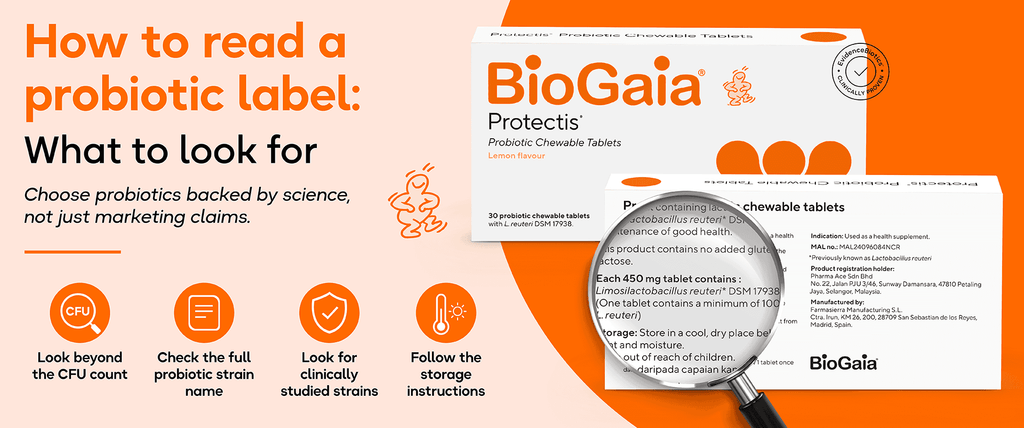
With so many probiotic products available, it’s easy to assume they’re all the same. However, a closer look at the label can help you identify products that are backed by science rather than marketing claims. Here are a few key things to look for:
- Look beyond the CFU count. While colony-forming units (CFUs) indicate the number of live bacteria, they don’t tell you whether those bacteria can survive stomach acid and reach the gut.
- Check the full probiotic strain name. A quality probiotic should list the genus, species, and strain. For example, Limosilactobacillus reuteri DSM 17938. Different strains within the same species can have very different health benefits.
- Look for clinically studied strains. Choose probiotics that are supported by published human clinical research, rather than relying solely on marketing claims. Scientific evidence provides greater confidence that the probiotic has been evaluated for safety and effectiveness.
- Follow the storage instructions. Heat and humidity can affect the viability of live probiotic bacteria. In Malaysia’s warm climate, always store probiotics according to the manufacturer’s recommendations to help maintain their quality throughout their shelf life.
Choosing the right probiotic isn’t about finding the highest CFU count. It’s about selecting a clinically studied strain with proven survival, appropriate formulation, and evidence to support its intended health benefits.
FAQ
Yes, stomach acid can destroy many probiotic bacteria before they reach the intestines. However, survival depends on the probiotic strain and how the product is formulated. Some clinically studied strains are naturally more tolerant of acidic conditions, while others rely on protective delivery technologies.
There isn’t a single “best” probiotic strain for everyone, as different strains have different functions. However, clinically studied strains such as Limosilactobacillus reuteri DSM 17938 have demonstrated the ability to survive passage through the stomach and reach the gastrointestinal tract.
The best time to take probiotics depends on the specific product and its instructions for use. Some probiotic strains are designed to be taken with food, while others can be taken on an empty stomach. Always follow the manufacturer’s recommendations for the product you are using.
Not necessarily. Refrigeration does not make probiotics more effective, but it may help preserve the viability of certain strains. Many modern probiotics are formulated to remain stable at room temperature. Always store probiotics according to the manufacturer’s instructions.
No. While colony-forming units (CFUs) indicate the number of live bacteria, a higher CFU count does not automatically mean a probiotic is more effective. The probiotic strain, clinical evidence, and ability to survive stomach acid are equally important.
Yes. Babies have stomach acid, although its acidity changes during early development. Infant probiotics that have been clinically studied are selected and formulated to survive passage through the digestive tract and support gut health in infants.
No. Different probiotic strains have different characteristics and health benefits. Even strains belonging to the same bacterial species may work differently, which is why probiotic research focuses on individual strains rather than the species alone.
The time varies depending on the probiotic strain and the health concern being addressed. Some people notice changes within a few days, while others may require several weeks of consistent daily use.
Many probiotics are formulated to remain stable at room temperature, while others require refrigeration. Because Malaysia has a warm and humid climate, it’s important to follow the storage instructions on the product label to help maintain probiotic viability.
Clinical studies help demonstrate whether a specific probiotic strain is safe, survives the digestive tract, and provides the intended health benefits. Choosing a clinically studied strain gives greater confidence in its effectiveness.
Most probiotics do not permanently colonise the gut. Instead, they temporarily interact with the gut microbiome and intestinal lining, where they can support digestive and immune health before being naturally eliminated from the body.
Look for a product that clearly identifies the probiotic strain, provides evidence from published clinical studies, includes storage instructions, and is manufactured by a reputable company with a strong scientific background.
Conclusion
When it comes to choosing a probiotic, more isn’t always better. While colony-forming units (CFUs) are important, they are only one part of the equation. A probiotic must first survive the harsh acidic environment of the stomach before it can reach the gut and provide its intended health benefits.
That’s why it’s important to look beyond the numbers on the label. Choosing a probiotic with a clinically studied strain, documented survival through the digestive tract, and proven health benefits gives you greater confidence that the bacteria will reach where they’re needed most.
If you’re looking for a probiotic backed by decades of scientific research, BioGaia offers a range of products containing clinically studied Limosilactobacillus reuteri strains designed to support gut health at every stage of life. Explore BioGaia’s probiotic range to find a product that’s right for your health needs and lifestyle.