
Key Takeaways
- Oral probiotics may support a healthier balance of bacteria in the mouth and contribute to better overall oral health.
- Specific probiotic strains have been studied for their potential to support healthier gums and reduce signs of gingival inflammation.
- Oral probiotics may help support the bacterial environment around dental plaque, but they do not physically remove plaque.
- Certain strains may also support fresher breath and a healthier environment around the teeth.
- Research has explored the use of specific L. reuteri strains for pregnancy gingivitis and as an adjunct to periodontal care.
- Probiotics should complement, not replace, brushing, interdental cleaning, a balanced diet and regular dental check-ups.
Probiotics are best known for supporting gut health, but certain strains may also benefit your mouth. Research suggests that oral probiotics can help support a balanced oral microbiome, healthier gums, fresher breath, and other aspects of dental health.
So, can probiotics improve oral health?
The answer may depend on the specific probiotic strain and how it is used. In this article, we look at seven ways probiotics may support your teeth and gums, and how they can fit into a complete oral-care routine.
How Do Oral Probiotics Work?
Oral probiotics are beneficial microorganisms selected for their potential to support the environment inside the mouth. Unlike brushing or flossing, they do not physically remove plaque. Instead, they work by interacting with the existing oral microbiome and may help create conditions that favour a healthier balance of bacteria.
Supporting a Healthy Oral Microbiome
Your mouth contains a wide variety of bacteria and other microorganisms. Many are harmless, while some can contribute to plaque buildup, gum irritation, and other oral health problems when they become too dominant.
Certain probiotics may help by competing with less desirable bacteria for space and nutrients. This can support a more balanced oral microbiome and may help maintain healthier gums and teeth over time.
Why the Probiotic Strain Matters
Not all probiotics provide the same benefits. Their effects are strain-specific, which means a probiotic used for digestive health may not have the same impact on oral health.
For this reason, it is important to look for strains that have been specifically studied for use in the mouth. For example, Limosilactobacillus reuteri strains such as DSM 17938 and ATCC PTA 5289 in BioGaia Prodentis Lozenges have been researched for their potential role in supporting oral and gum health.
7 Ways Probiotics Can Support Your Oral Health
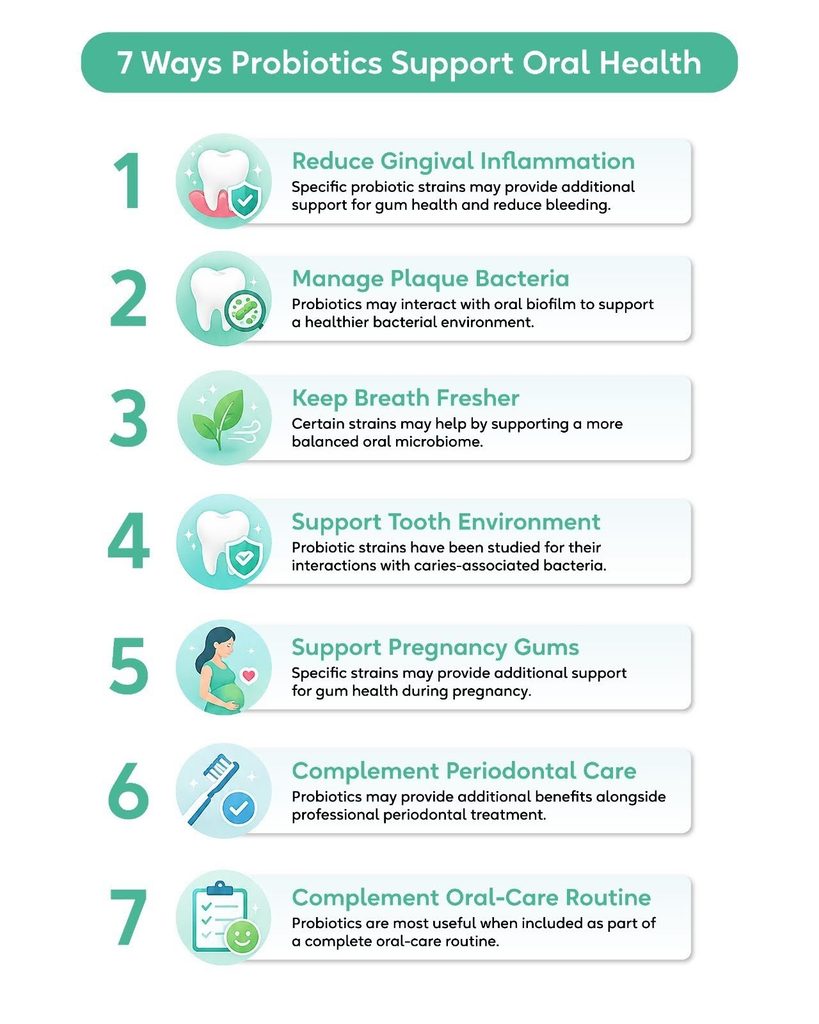
Oral probiotics may support several aspects of oral health, but their effects depend on the strains used. Research on specific probiotic strains has explored their role in gum health, plaque control, bad breath, tooth health, and periodontal care.
Not all probiotic strains are created equal. Even within the same bacterial species, different strains can have very different characteristics, which is why clinical research focuses on specific probiotic strains, not just the species name.
1. Reduce Gingival Inflammation and Support Healthier Gums
Gingival inflammation can cause redness, swelling, tenderness, and bleeding during brushing or flossing. Plaque buildup around the gumline is one of the main triggers.
Certain oral probiotics have been studied for their potential to support healthier gums. In a double-blind, placebo-controlled study involving 42 adults with moderate gingival inflammation, participants who received Limosiactobacillus reuteri DSM 17938 and ATCC PTA 5289 showed improvements in bleeding on probing. Changes in some inflammatory markers were also observed.
This suggests that specific probiotic strains may provide additional support for gum health. However, probiotics should complement good plaque control and professional dental care, not replace them.
2. Manage Plaque-Associated Bacteria
Dental plaque is a bacterial biofilm that continuously forms on the teeth and along the gumline. If it is not removed regularly, it can contribute to gum irritation and inflammation. Plaque accumulation also plays an important role in the development of gingivitis.
Certain oral probiotics may interact with microorganisms within the oral biofilm and help support a healthier bacterial environment. For instance, research on specific L. reuteri strains has reported reductions in selected periodontal bacteria within the oral microbiota.
However, probiotics do not physically remove plaque. Brushing twice a day and cleaning between the teeth remain essential because these habits mechanically disrupt plaque before it builds up.
3. Keep Your Breath Fresher
Bad breath can have several causes, including poor oral hygiene and periodontal problems. Certain bacteria in the mouth produce volatile sulphur compounds that contribute to unpleasant odours. Bad breath, or halitosis, may also be associated with an imbalance in the oral microbiome.
Oral probiotics take a different approach from mints or sprays that simply mask odour. Research suggests that certain strains may help reduce oral malodour by supporting a more balanced oral microbiome.
4. Support a Healthier Environment for Your Teeth
Your oral microbiome also influences the environment around your teeth. Tooth decay develops through several interacting factors, including bacteria, frequent sugar exposure, saliva, oral hygiene, and fluoride exposure.
Tooth decay is linked to disruption of the oral biofilm and mutans streptococci bacteria are often involved in creating acidic conditions that can contribute to enamel demineralisation.
Certain probiotic strains have therefore been studied for their interactions with caries-associated bacteria.
However, brushing with fluoride toothpaste, limiting frequent sugar intake, and maintaining regular dental check-ups remain essential.
5. They May Support Gum Health During Pregnancy
Pregnancy can change the way the gums respond to plaque. Hormonal and immune changes may make the gums more prone to redness, swelling, and bleeding, a condition commonly known as pregnancy gingivitis.
Specific oral probiotics have been studied in this area. In a randomised controlled trial involving 45 pregnant women with pregnancy gingivitis, participants received either placebo lozenges or lozenges containing L. reuteri DSM 17938 and ATCC PTA 5289. After around seven weeks, the probiotic group had lower Gingival Index and Plaque Index scores than the placebo group.
This suggests that these strains may provide additional support for gum health during pregnancy. They should still be used alongside regular oral hygiene and appropriate dental care.
6. Complement Periodontal Care
Gingivitis affects the gums, while periodontitis is a more advanced condition that can damage the tissues and bone supporting the teeth and requires professional dental care.
Researchers have investigated whether probiotics may provide additional benefits alongside professional periodontal treatment. In a double-blind, placebo-controlled pilot study of patients receiving supportive periodontal therapy, those receiving L. reuteri DSM 17938 and ATCC PTA 5289 showed greater improvements in some measures, including probing pocket depth and bleeding on probing, at certain follow-up points.
7. Complement Your Everyday Oral-Care Routine
Oral probiotics such as BioGaia Prodentis is often most useful when they are included as part of a complete oral-care routine. It contains Limosilactobacillus reuteri DSM 17938 and ATCC PTA 5289, two strains used specifically in its oral-care formulation.
Your everyday oral-care routine should still include:
- Brushing twice daily with fluoride toothpaste.
- Cleaning between the teeth with floss or interdental brushes.
- Maintaining a balanced diet.
- Attending regular dental check-ups.
- Using oral probiotics according to the product instructions.
By combining good mechanical cleaning with support for the oral microbiome, probiotics may offer an additional way to care for your teeth and gums.
When to Seek Professional Advice for Gum Problems
Oral probiotics can support gum health, but they are not a substitute for professional dental care. If gum symptoms continue or become more severe, it is important to have them checked by a dentist.
Seek professional advice if you notice:
- Frequent bleeding when brushing or flossing.
- Persistent redness, swelling, or tenderness.
- Receding gums.
- Ongoing bad breath.
- Loose teeth.
- Pus around the gumline.
- Pain when chewing.
These signs may point to gingivitis, periodontitis, or another oral health issue that needs proper assessment.
If bleeding gums are a recurring concern, read ‘Your Gums Are Bleeding: Here’s What They May Be Telling You’.
FAQ
Yes, certain probiotic strains may help support oral health by promoting a healthier oral microbiome. Research has explored their benefits in gum health, gingival inflammation, plaque-associated bacteria, and bad breath. Importantly, probiotics should be used alongside regular brushing, flossing, and dental care.
Certain probiotic strains, like L.reuteri strains in BioGaia Prodentis have been studied as an adjunct to conventional oral care for gingivitis. Some research has reported improvements in measures such as bleeding on probing and gingival inflammation.
No. Probiotic effects are strain-specific, so a strain used for digestive health may not provide the same benefits in the mouth. Oral probiotics are selected and formulated for oral use, which is why it is important to choose strains that have been specifically studied for oral health.
The time needed to notice changes can vary depending on the probiotic strain, the oral health concern, and how consistently the product is used. Clinical studies often assess outcomes over several weeks, so oral probiotics are generally best viewed as part of an ongoing oral-care routine rather than a quick fix.
Oral probiotics and mouthwash work differently. Oral probiotics support a balanced oral microbiome by introducing beneficial bacteria, whereas certain mouthwashes work by reducing bacteria more broadly or providing temporary breath freshening. Oral probiotics can be incorporated into a daily oral-care routine alongside regular brushing, flossing, and professional dental care.
The best timing depends on the specific product instructions. Some oral probiotics are designed to be used after brushing and flossing so the probiotic strains can remain in contact with the mouth for longer. Always follow the directions provided with the product.
Conclusion: Supporting Better Oral Health With Probiotics
Oral probiotics can be a useful addition to your daily dental-care routine, especially when specific strains are chosen for oral health. They may help support healthier gums, a more balanced oral microbiome, fresher breath, and better overall oral care.
However, probiotics work best alongside the basics: regular brushing, interdental cleaning, a balanced diet, and routine dental check-ups.
To learn more about how specific probiotic strains can support your teeth and gums, explore BioGaia’s oral care solutions.
Find out more about probiotics and gum care, read:
- Pregnancy Gingivitis: Why Your Gums Bleed More During Pregnancy and How Oral Probiotics Help
- Can Gum Health Affect the Rest of Your Body? Understanding the Oral–Systemic Connection